
Peoria Directory Shelves by Year
Peoria's historical directory record is broad but distributed. The Peoria County Genealogical Society reports a nearly complete run beginning in 1844. Peoria Public Library holds directories from the mid-1800s forward, while individual catalogs and finding aids identify selected editions. Internet Archive provides a fully viewable 1910–1911 example. Because no official online index spans every year, describe each collection by its own stated coverage.
| Collection | Years | Where Held | Access |
|---|---|---|---|
| PCGS city directory run | Beginning 1844, nearly complete | Peoria County Genealogical Society | Research and targeted lookup route |
| PPL city directories | Mid-1800s forward | Public Library Local History Room | In person; staff help; some digital aids |
| Franks directory | 1910–1911 edition | Internet Archive | Free scanned volume and OCR |
| Root's directories | 1870–1874, 1877, 1879 | Illinois SHPO/HABS finding aid | Holdings guide; retrieve through an archive |
| Polk examples | 1950, 1960, 1970, 1980, 1990 | Illinois SHPO/HABS finding aid | Finding aid, not a complete digital run |
| Newberry directory item | 1903 | Newberry Library | Catalog and reading-room rules |
The final printed year was not verified in one authoritative catalog. Do not fill a missing year by assuming annual publication. Contact the holder with the surname, street, and year range, then ask whether the volume, street cross-index, or phone book is available.
Peoria Library History Room
The Peoria Public Library Local History and Genealogy Room is on the Main Library's lower level. Posted hours are Monday through Saturday, 9:00 a.m. to 6:00 p.m., and the main phone is 309-497-2000. Its city directories sit beside Peoria newspapers from 1837 through 2018 on microfilm, Journal Star access from 1951 forward, obituary tools, county vital statistics, family histories, yearbooks, Caterpillar News & Views, cemetery indexes, Sanborn maps, and county histories.
That mix matters. A directory residence can be checked against a death notice, school yearbook, map sheet, or news item without leaving the collection. Licensed tools include Ancestry Library Edition in the building, HeritageQuest with a library card and PIN, Heritage Hub obituary coverage, and a FamilySearch affiliate connection. Email Questions@ppl.peoria.lib.il.us with a narrow name, year, and source request.
Inside Peoria's 1910 Directory
The 1910–1911 Franks edition calls itself the publisher's 29th year and reports 47,456 names. That number is an interest-layer local story, not a population count. Entries combine a person's name with status or spouse notation, occupation, business or institution, and a residence address. Some examples connect workers to named firms, while others distinguish a business site from the residence.
The Internet Archive scan of the 1910 Peoria city directory is the best direct way to see this format.

Search OCR to find a likely page, then inspect the image. Preserve the printed spelling, page number, and key because OCR often confuses initials, type, and old street names.
Decode a Peoria Directory Entry
A city directory entry is a compact historical statement. It may identify a person at a residence, connect that person to work or an institution, and note marital or widow status. It does not prove legal ownership. Read the abbreviation key for that exact edition before expanding any mark.
| Name | Printed surname, given name or initials, sometimes spouse or status detail |
|---|---|
| Occupation | Trade, role, employer, business, or institution where the edition supplies it |
| Residence | House number and street; r means residence in the Franks volume |
| Business address | A separate work or firm location that should not be mistaken for the home |
| Widow notation | A dated status clue that can lead to newspapers, probate, or cemetery material |
- Criss-cross directory
- A volume or section arranged by street and house number, useful when the address is known but the surname is not.
- Householder index
- An address-ordered list of named people associated with homes in the edition's coverage area.
- Abbreviation key
- The publisher's legend for shortened status, occupation, address, and household terms; save it with every transcription.
Common surnames need a second point of identity. Compare initials, spouse, occupation, institution, and address. A directory year shows what the publisher gathered for that edition, not an uninterrupted residence.
Peoria Directory Cross-Indexes
The Peoria County Genealogical Society research collection adds indexes by occupation, business, and street to its directory run. Its supporting holdings include biographical dictionaries from roughly 1880 to 1912, indexes or abstracts for 15 area newspapers from 1834 to 1864, maps, Sanborn material, and about 275 linear feet of files on families, streets, firms, and organizations.
The society also reports probate coverage from 1825 to 1922, Boland Mortuary records from 1925 to 1978, cemetery records for the city and 19 townships, undertaker books from 1872 to 1915, naturalization aids, and an 1888 Peoria census index. Those sources help explain a person's disappearance or move between city directory years. Mail inquiries go to PO Box 1489, Peoria, Illinois 61655-1489.
The manifest capture of the PCGS research resources shows the collection route.

Ask for one surname, street, or year range at a time so staff can identify a volume and page.
The society's Peoria County record indexes provide the next step after a directory clue.
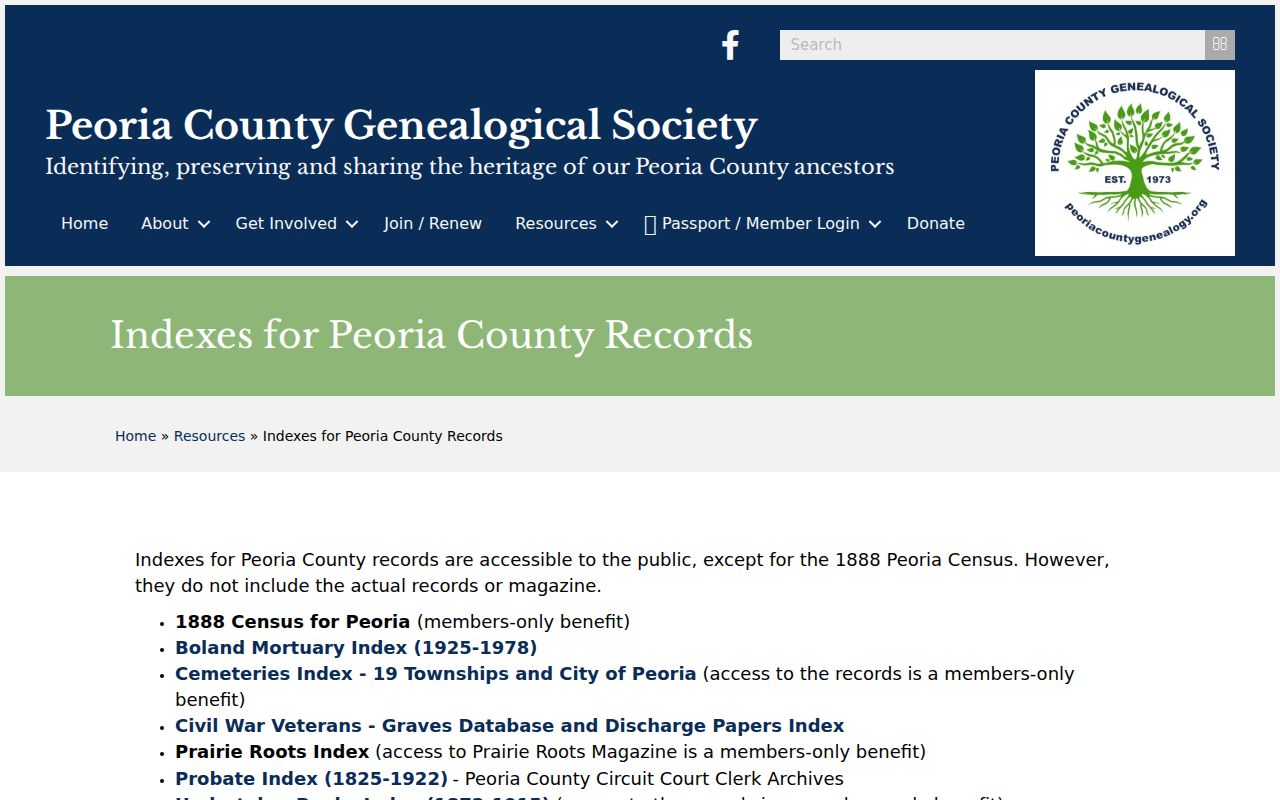
Use the named index to locate a probate, cemetery, mortuary, or naturalization reference, then request the underlying record.
Peoria Directory Archive Images
The Peoria Historical Society archive search accepts a keyword plus Type, date range, collection, item type, creator or photographer, and place. Its archive is at 611 SW Washington Street, with posted Tuesday through Friday hours of 9:00 a.m. to 4:30 p.m. and phone 309-674-1921. Search a directory name together with a street, organization, or firm to locate images and vertical-file context.
The source capture shows the Historical Society catalog controls.
A catalog result is a finding aid. Cite the collection, item, creator, date, and reproduction terms after viewing the record.
Peoria Yearbooks and Sanborn Sheets
Bradley University holds Polyscope yearbooks from 1901 through 1949, city directories, vertical files, Internet Archive material, and street photographs. For a former classmate, combine the school year with a directory address, a newspaper notice, and the scanned yearbook page. This human-use method is more dependable than a modern surname-only search because it anchors the person to an institution and date.
Sanborn fire-insurance maps describe the building behind a directory address rather than its occupants. The Library of Congress has digitized Peoria sheets, including a 1902 item. University of Illinois material describes four volumes covering downtown, east and west sides, North End, South End, Averyville, and outlying areas. State Geological Survey holdings list Peoria society maps for 1891, 1900, 1918, 1927, 1928, 1943, 1946, and 1947.
Match the map date and sheet to the directory year. Record both citations. A building footprint or use label can confirm place context but cannot identify a household by itself.
Peoria Directory Record Timeline
Local directory history is layered across publishers and repositories. The timeline uses only years verified in the research and does not imply that every intervening edition survives.
| 1844 | Beginning of the nearly complete PCGS-reported directory run |
|---|---|
| 1870s | Root's editions identified for 1870–1874, 1877, and 1879 |
| 1903 | Peoria directory item cataloged by the Newberry Library |
| 1910–1911 | Franks 29th-year edition reports 47,456 names |
| 1950–1990 | Selected decade Polk examples appear in the SHPO/HABS guide |
| 2022 | The 1950 federal census opened under the 72-year rule |
The Peoria city directory shelf complements county records transferred to IRAD and later digital indexes. A modern portal's start date does not mean older evidence disappeared.
Trace Families Through Peoria Directories
Follow a household across several city directory editions, then pair those snapshots with census, obituary, cemetery, probate, and newspaper sources. The Peoria directories can fill years between released federal censuses, but an absent entry has several explanations: the person moved, died, was omitted, used different initials, lived beyond that edition's city limits, or appeared under a spouse's name.
- Build a variant list with full name, initials, married or widow forms, and likely OCR errors.
- Find the earliest likely entry. Save the title, year, page, address, occupation, and status marks.
- Move forward one available edition at a time. Track each address and change in work or household notation.
- Check the street or criss-cross index for the same address and nearby names, without assuming relationships.
- Pair the directory years with released census records, newspapers, obituaries, probate, maps, and cemetery indexes.
When OCR fails, browse nearby pages and search the street. When a name vanishes, start with the library obituary tools and PCGS indexes, then ask IRAD or the court custodian about a specific probate series. A directory entry remains historical evidence, not proof of a current address or relationship.
Note: The 1960 census is scheduled for public release in 2032, so current family-history work must bridge that later gap with other sources.