
Peoria Previous Residents by Era
No one record names every person connected with a Peoria address. The current parcel record supplies the stable PIN, or parcel identification number, plus the situs address and legal description. Recorded deeds identify parties to transfers. Printed directories can place a person or business at a street number, and released census schedules can show a household. The useful source changes as the trail moves back in time.
| Source | Years It Covers | Where Held | What It Shows |
|---|---|---|---|
| County parcel and GIS records | Current data and captured tax years | Peoria County tax portal and GIS | PIN, situs, owner mailing address, legal description, sale and building fields |
| EagleWeb land index | All-field search from 1987; older route from 1819 | Peoria County Clerk / Recorder | Grantors, grantees, dates, instrument type, Book/Page and legal references |
| Peoria city directories | Nearly complete run beginning 1844 | PCGS, Peoria Public Library, and selected digital scans | Names, residence, work, business, status, and street cross-indexes |
| Federal census schedules | Released decennial schedules through 1950 | NARA and library databases | Household members and census-place context |
| Probate and local archives | Probate index 1825–1887; other series vary | IRAD at WIU, PCGS, and courthouse files | Estate names, case references, heirs, assessor and court clues |
Start with the tax and GIS record even when the goal is an old household. That modern record fixes the parcel before changing street forms cause a false match. For a late twentieth-century transfer, move into EagleWeb. For an earlier occupant, use the recorder's Book/Page path, then compare directory and census years. A historical name found only in a directory is an occupancy clue, not proof of title.
Fix Peoria Previous-Resident Parcels
The Peoria County Property Tax Inquiry accepts a parcel number, owner name, or address criteria. Its own search hints favor a PIN for an exact result. With an address, use the house number and plain street name first. Extra direction or suffix text can hide a valid result. Save the PIN, property or situs address, owner's mailing address, and legal description as separate fields.
The Peoria County GIS viewer adds the parcel shape and building, neighborhood, assessment, and sale fields. A mailing address may be far from the building, so it cannot establish who occupied the site. The legal description is more durable than a street label and is the best check when the chain reaches old plats or deed books.
Note: A tax owner, mailing addressee, and previous resident can be three different people, even when all appear beside the same parcel.
Trace Peoria Previous Owners
The Peoria County EagleWeb index connects the present parcel to earlier owners. Current all-field searching covers 1987 forward. Material from 1819 through 1986 uses document number, Book/Page, or historical indexes, while the recorder's About page dates document data and images from December 12, 1913. Those overlapping statements describe distinct search paths, not one seamless online span.
- Copy the current PIN, owner, situs, and legal description from the county parcel result.
- Search the owner as grantee in EagleWeb, narrow by date and instrument type, and open or request the purchase deed.
- Record the grantor, reception number, recording date, and exact legal description shown on that instrument.
- Search that seller as a grantee to locate the prior purchase. Compare the land description before accepting the name match.
- Repeat until the searchable path ends, then use the historical index, recorder counter, Book/Page reference, or IRAD holding.
- Grantor / grantee
- The grantor gives an interest in land; the grantee receives it.
- Chain of title
- The sequence of recorded transfers affecting the same land.
- Legal description
- The lot, block, subdivision, or metes-and-bounds text that identifies land despite address changes.
Peoria Previous Residents Deed Index
EagleWeb's split is a Peoria records quirk worth logging in the research notes. Basic name search is order-sensitive. Advanced search works by words and supports wildcard, required, and excluded terms. The form also offers grantor, grantee, combined party, date, document type, reception number, subdivision, block, and lot controls. “Find Related” can follow a shared legal description or a reference in another instrument.
The public index search is free, but a result is still a finding aid. Confirm the image or obtain the instrument. The county warns that its index is not a replacement for the recorded document. If the web gateway fails, public-search stations at the recorder's office operate during posted weekday hours, and staff can route an instrument-copy request. The County Clerk / Recorder is at 324 Main Street, Room 101, and the recorder phone is 309-672-6090.
The Peoria County Land Records page is the source for the recorder route shown below.
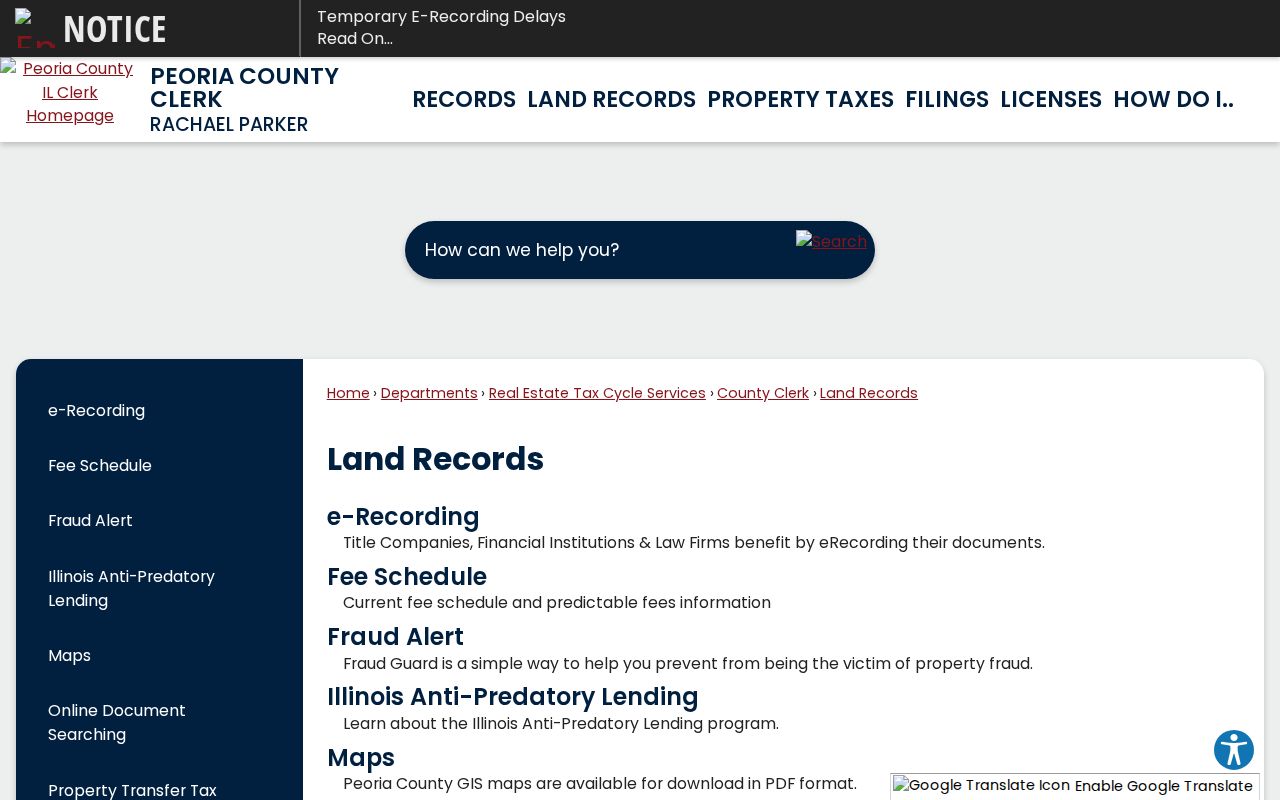
The county page is the dependable handoff when EagleWeb, an image control, or a historical reference does not load.
Map Previous Peoria Households
Sanborn fire-insurance maps date the built setting around an address. They show building footprints, construction context, street lines, and uses, but they do not form an occupant list. The Library of Congress has digitized Peoria sheets, including a 1902 item. University of Illinois holdings describe four city volumes and sheet ranges for downtown, the east and west sides, North End, South End, Averyville, and outlying areas.
The Illinois State Geological Survey finding aid also reports Peoria Historical Society sheets for 1891, 1900, 1918, 1927, 1928, 1943, 1946, and 1947. Match the directory year to the closest map edition. Cite the sheet and date. If an old street number does not align with the modern parcel, check city plats, the directory title, and Public Works records. The research found no official citywide renumbering list, so a neat one-to-one conversion should never be guessed.
Pair Peoria Resident Records
Ownership is only one layer. Peoria Public Library and the Peoria County Genealogical Society hold directories that can place past residents, boarders, workers, or businesses at an address. PCGS reports a nearly complete run beginning in 1844 with street, business, and occupation cross-indexes. The digitized 1910–1911 Franks volume reports 47,456 names and uses an r to mark a residence. Its other status and work notes can separate a home from a business site.
Use a short sequence instead of treating one printed line as final:
- Search the street and number in the directory year nearest a released census.
- Save the printed page, spelling, status marks, work entry, and directory title.
- Find the census enumeration area and compare household names, ages, and relationships.
- Check the directory before and after that census year to bound the move-in and move-out period.
- Return to deeds, news, or probate only when the name and parcel evidence agree.
The full collection details belong with the Peoria city directory. For this backward trail, each volume is used as a dated snapshot of who lived here before, not as proof of land ownership.
Lawful use. Research previous residents for house history, genealogy, or an estate question. Never use a living person's address trail to stalk, harass, threaten, or cause harm.
Peoria Previous Resident Probate Links
An obituary can connect a former address to relatives, a work site, a cemetery, or a service date. Peoria Public Library provides newspaper microfilm from 1837 through 2018, Journal Star access from 1951 forward, and obituary and death-notice tools. PCGS adds cemetery, mortuary, undertaker, and probate indexes. Preserve the notice date and page because a surname alone is not enough.
The IRAD Peoria probate index contains 3,105 entries from 1825 through 1887. Search by estate name and try alternate spelling. An index result points to the file; the estate papers may identify heirs, an administrator, and land that can be checked against the deed chain. Later or unindexed probate material may require the Circuit Clerk, PCGS, or a targeted archive request.
The Western Illinois University regional depository explains the research and copy route pictured here.
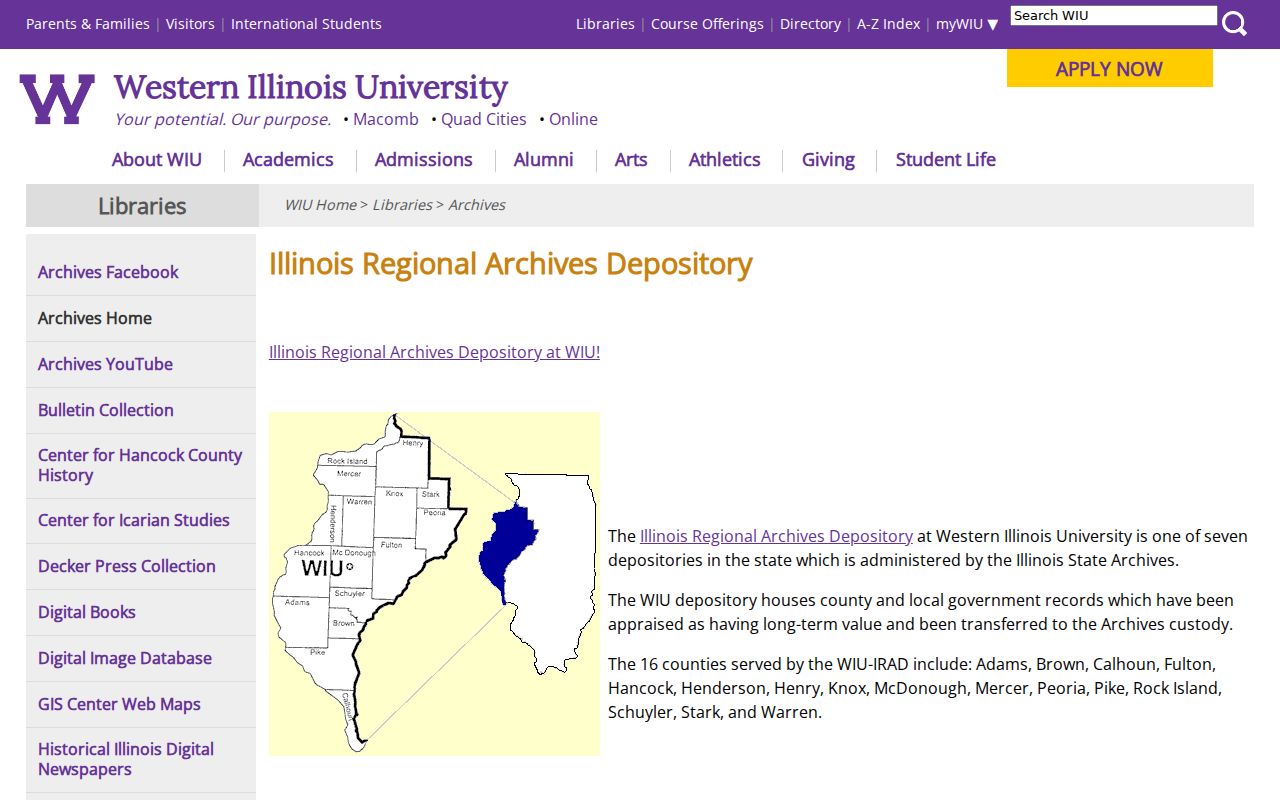
Use the depository after noting the exact county, record group, date span, name, and index reference, which gives staff a tractable request.
Peoria Records Survive in Layers
Peoria County was organized in 1825, and the present courthouse was dedicated in 1965. Neither date marks a total loss or a full digital conversion. The research found no official account of a catastrophic courthouse fire. Older assessor, probate, election, and court volumes were transferred in parts to IRAD, while recorder Book/Page references, local directories, and newspaper images remain with other keepers.
This layered custody explains many apparent gaps. Write down the series that failed, its searched years, and its holder. Then try the recorder counter, IRAD at WIU, Peoria Public Library, PCGS, or the Peoria Historical Society with a narrow name, street, and date request. A “no web result” is not proof that no record exists. It often means that previous residents of the Peoria parcel sit in a book, scan, microfilm reel, or file rather than the current index.